
The agony and ecstasy of stitching dozens of photos together to get the perfect flash composite for weddings.
You have have seen some of my flash composites for weddings on my site already. Often, my use of flash is something that stands out in my work and composites are one tool I use to bring something extra to photos.
I strive to at every wedding to outdo my past work – to deliver something even more creative, authentic, meaningful, beautiful, for my clients. But then I sit down on Sundays to edit, and sometimes I wish I had tried a little less hard!
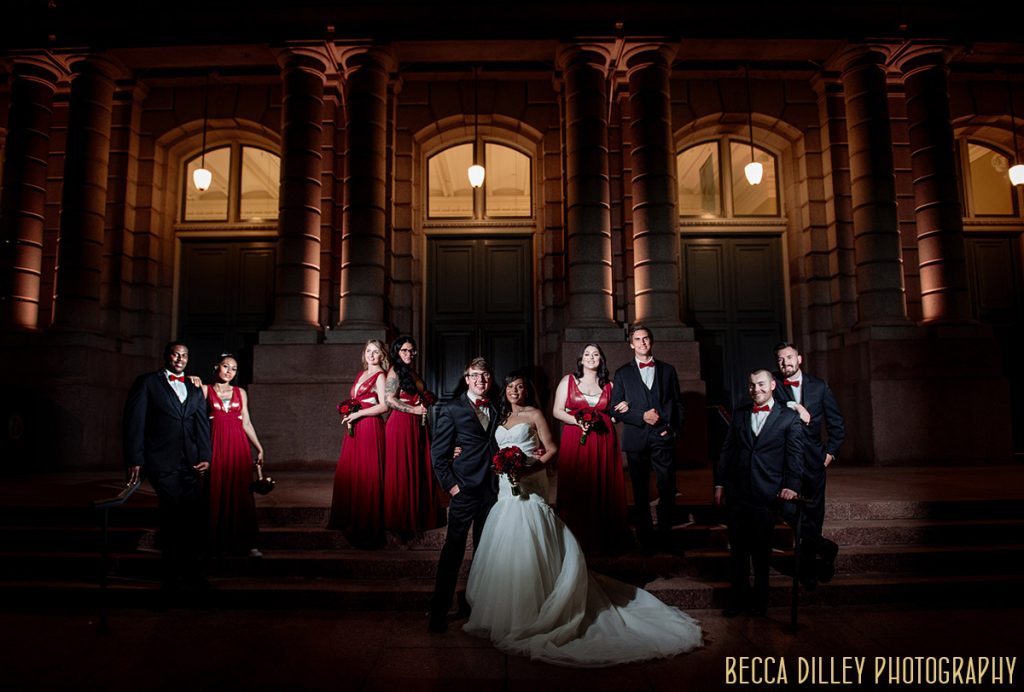
Joking, obviously, but one of the main time culprits is the flash composite. A flash composite requires combining multiple images to bring out the best exposed aspects of each image.

I generally use these for large wedding party portraits, where the effect would be impossible any other way. These require having an assistant photographer hold the light on each individual person or group while I capture the image for each grouping. Then I edit the multiple images (generally 6-15 depending on the image) layer them together, and combine the properly exposed parts. It is a bit technical and tedious, but after editing hundreds of weddings and making nearly as many flash composites, it is still technical and tedious and I just make a coffee while everything renders.
But the effect, I think, is worth the effort.
3 reasons why I do this much work to create flash composites for weddings

1. Flash composites are not possible with a camera phone
This is increasingly relevant give how good modern phone cameras have gotten. There used to be a larger bag of tools that were firmly in the “guests can’t document this with their phones/pocket cameras” category, but many of those tools (like shallow depth of field, or photos at night) are now much more possible. And honestly, that’s great. In general, I love that guests can get great portraits of themselves at weddings, or an image of the first dance, and have something reflective of the day and often properly exposed!

For my fellow camera/lighting nerds, I will say that you could get close to this effect with multiple camera lights narrowly focused on each grouping, but that isn’t practical for weddings, and the quality of light would be harsher.
2. Flash composites create drama with lighting, perfect for wedding locations
Some spaces are ready to hold more dramatic stories. This is why flash composites are all over Hollywood posters and vogue covers.
Flash composites are multi steps and complicated, and thus are a differentiator for me as a photographer, and for the couple as they look thorough their images. It is a portrait that screams “now that is unexpected” and forces you to slow down and notice.


3. Everyone gets the lighting the deserve with a flash composite technique
Have you ever been in a wedding and when you look at the group photos you are on the end and out of focus or making a face? Because that is me in most weddings (I make a lot of faces when I talk, apparently!) A flash composite allows each person in the image to be properly and similarly exposed to light. For most images, I will focus the best lighting and composition on the couple – if all else fails, that must be right. That means that by necessity there are things that get less attention. But not so for a flash composite! – balancing the light on people means you get to see everyone at their best – its like a series of individual portraits.




How a flash composite is made
Here is a behind the scenes video of combining layers in photoshop to make this flash composite at a gorgeous wedding at 7 Vines Vineyard in Minnesota. The video is sped up (and not perfectly color balanced – let me know if seeing more of these would be helpful and I’ll try harder with recording video!).

Planning a wedding in Minneapolis?
If you are looking for a photographer for your Minneapolis wedding, I’d love to connect with you! You deserve to relive all the energy and excitement of your event through the images!
